Paving a Path to a More Equitable Future for Manitoba’s Children and Families
A Research Framework for Impact
Research at CHRIM includes a broad spectrum of disciplines ranging from pre-clinical (laboratory) biomedical research using cells or animals through to clinical research on human subjects, to data-focused epidemiological studies, or to examining how to get research evidence into the hands of decision makers. Researchers may focus on a certain disease or condition (such as respiratory, endocrinological, or neurological disorders), on a certain stage of development (prenatal/maternal, infancy, child, youth or family), or on a certain context (such as emergency care, Indigenous health, mental health, and/or socioeconomic, psychological or other environmental stressors).
Working across disciplines and in various contexts, research at CHRIM seeks to impact child health and wellness through three interrelated approaches:
- Understanding the determinants of health and wellness – these may be social, environmental, biological, or a combination
- Developing interventions and therapeutics – including health promotion, disease prevention, social programs, surgeries, or pharmaceuticals
- Increasing knowledge mobilization – ensuring research evidence is used to inform policy decisions and clinical care guidelines
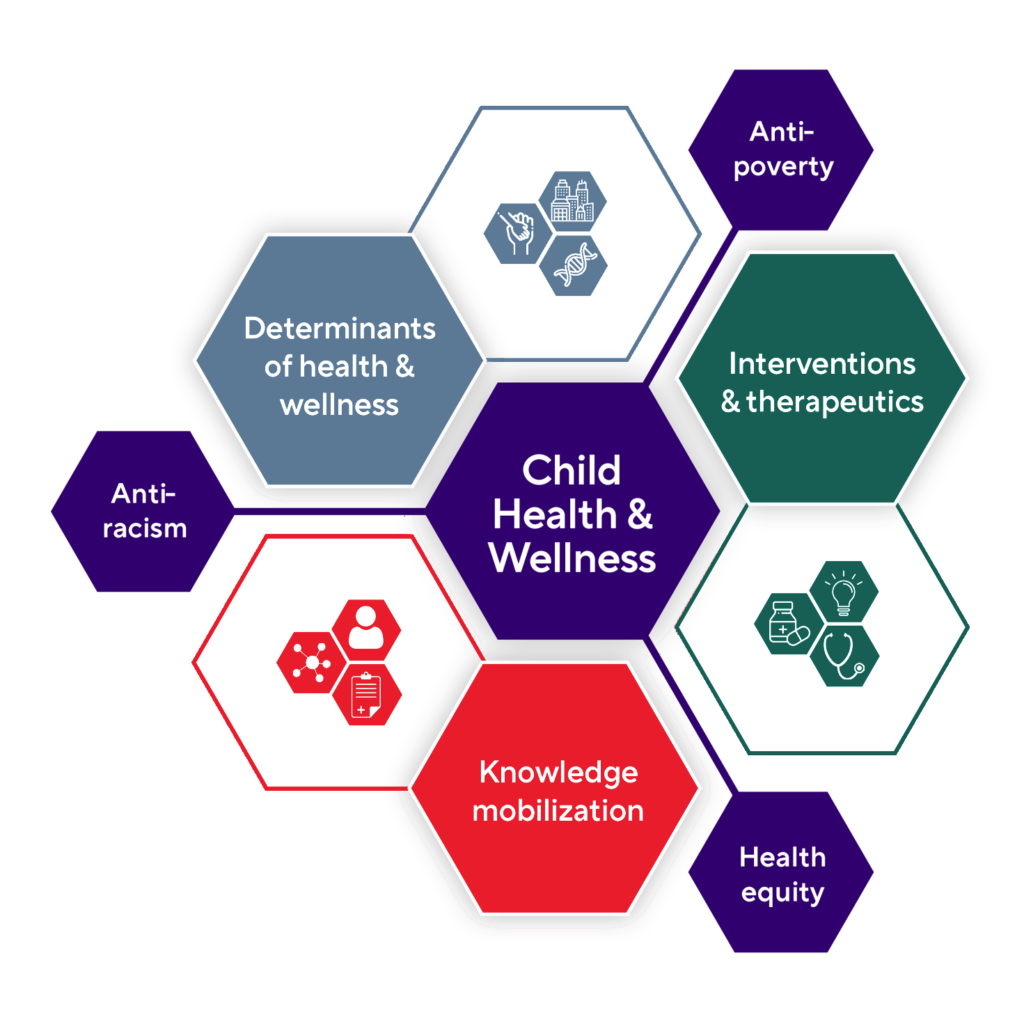
Accessible Text Description: Visualisation of the Horizon 2026 framework showcasing the interconnectedness of child health & wellness, anti-racism, anti-poverty, and health equity; tackling these requires understanding determinants of health & wellness, developing interventions & therapeutics, and increasing knowledge mobilization.
The inclusion of health equity, anti-poverty and anti-racism in this framework communicates our intent to apply these values in all our activities, through education of ourselves and others as well as through advocacy for systemic changes that will promote health equity, reduce poverty and address racism. We recognize we as a research institute need to be educated and informed with respect to these values so that we can educate and inform others and advocate effectively for the needs of all Manitoba families.
In 2016, the Children’s Hospital Research Institute of Manitoba established a strategic plan with four priorities: Helping Kids, Supporting Researchers, Elevating the Brand, and Increasing Funding. Many organizational changes have been made to advance in each of these areas.
As the world slowly emerges from the (sometimes seemingly interminable) COVID-19 pandemic, we as Manitoba’s centre of child health research are positioning ourselves to look outward to the health and wellness of children in Manitoba. The urgent need for change has been brought to our attention by the Unicef Report Card 16 (2020), in which Canada ranked 30th out of 38 OECD countries in child well-being outcomes, in spite of our having among the best economic, environmental and social conditions for growing up. The pandemic has further widened inequalities for vulnerable populations, who fare worse in every metric. Even more sobering is the evidence that Manitoba has the highest rate of child poverty of all Canadian provinces.
The engagement work of #WeCANforKids has resulted in Inspiring Healthy Futures, a Canada-wide vision for a better future for children, youth and families. We at CHRIM wish to join in this vision by identifying areas of impact and influence where the institute may be empowered, or empower others, to effect real change, especially in Manitoba.
CHRIM as an organization remains fully committed to helping kids and supporting researchers as well as to increasing our visibility and financial sustainability. Going forward, we want to add a lens of equity to set a research agenda intended to have real-world impact on child health and wellness in Manitoba. This agenda will be shaped by CHRIM’s strengths, the needs of Manitoba families, and existing trends and opportunities. It will guide the Institute in all its activities:
- Organizational structure and function
- Telling our story (and changing that story where needed)
- How we work and where our focus is
We are calling this strategic research agenda Horizon 2026 because it will be a beacon that will guide the collective action of CHRIM leadership and community over the next few years as we seek to engage with Manitoba researchers, health-care providers, policymakers and families to maximize our impact and influence on child health and wellness in this province. Notably, the emphasis should be on the Horizon and not on the year 2026; it would be foolish and short-sighted to think we will have “arrived” by this date. Because this process began in 2021, we chose a 5-year horizon to give us time to set in motion certain ongoing actions that will gain momentum as we learn and grow together. Rather than a fixed plan with immovable goals, we will seek to perpetually check our path and make choices to adjust course and steer towards a vison of health equity fueled by actions of anti-poverty and anti-racism.
Reconciliation with Indigenous Peoples in Manitoba is a focal point of this lens of equity. Building on a territorial acknowledgement to open our events, this is a shift to truly see, hear, and partner with the Indigenous children and families of our province in all that we do. We recognize that if we are to truly make an impact with our research, we must represent all Manitobans. Because we are all products of a colonial system that is inherently racist and biased towards the privileged, this presents a monumental challenge. We commit to taking active steps of policy, education and advocacy that are anti-racist and align with the University of Manitoba Disruption of All Forms of Racism policy.
Below is an introductory summary that outlines the opportunities that were presented during the conversations we had within our community in 2021 and presents a plan to keep the horizon of equity in sight as we move forward in a spirit of openness, truth and reconciliation.
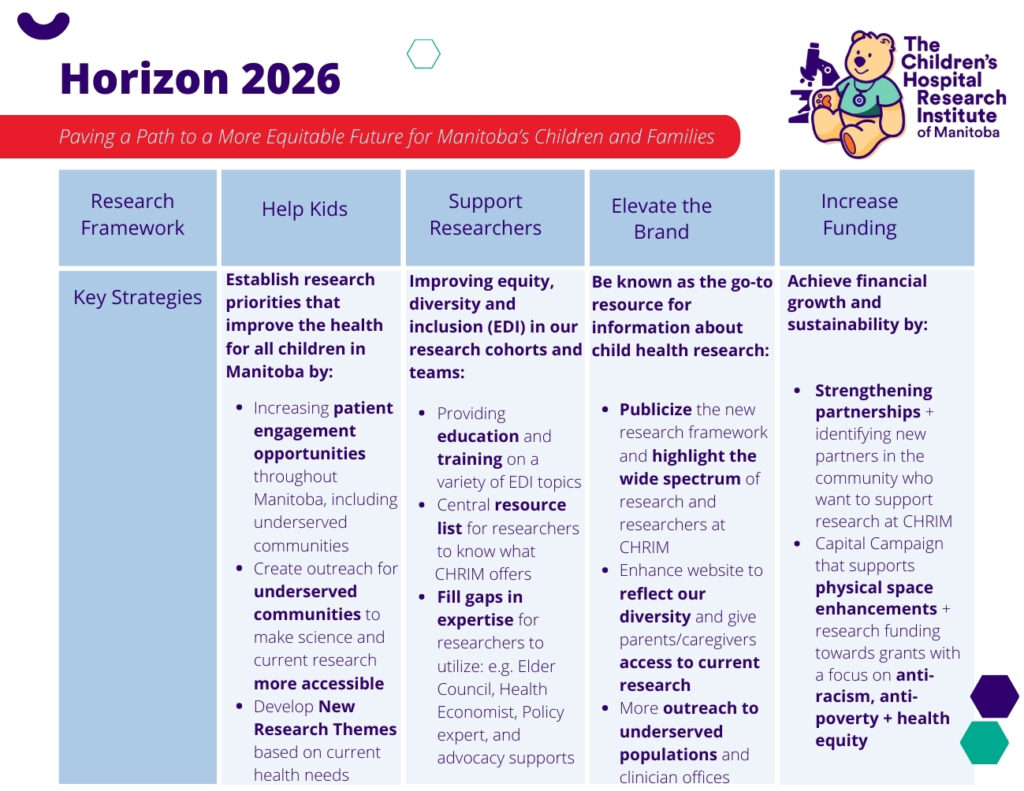
Accessible Text Description: Visualization table of the Horizon 2026 plan, paving a path to a more equitable future for Manitoba’s children and families. There are four research frameworks, each with a key strategy and action items.
The first research framework is helping kids. The key strategy is to establish research priorities that improve the health for all children in Manitoba by:
- Increasing patient engagement opportunities throughout Manitoba, including underserved communities.
- Creating outreach for underserved communities to make science and current research more accessible.
- Developing new research themes based on current health needs.
The second research framework is supporting researchers. The key strategy is to support in improving equity, diversity, and inclusion (EDI) in our research cohorts and teams by:
- Providing education and training on a variety of EDI topics.
- Creating a central resource list for researchers to know what CHRIM offers.
- Filling gaps in expertise for researchers to utilize: e.g. Elder Council, Health Economist, Policy Expert, and Advocacy Supports.
The third research framework is elevating the brand. The key strategy is to be known as the go-to resource for informataion about child health research by:
- Publicizing the new research framework and highlighting the wide spectrum of research and researchers at CHRIM.
- Creating a new website that reflects our diversity and gives parents and caregivers access to current research.
- Providing more outreach to underserved populations and clinician offices.
The fourth research framework is increasing funding. The key strategy is to achieve financial growth and sustainability by:
- Strengthening partnerships and identifying new partners in the community who want to support research at CHRIM.
- Running a Capital Campaign that supports physical space enhancements and research funding towards grants with a focus on anti-racism, anti-poverty, and health equity.