
A group of patient co-researchers has been working with Dr. Jonathan McGavock and a team of researchers from Diabetes Action Canada since 2020 to co-design exercise studies that meet the needs of people living with type 1 diabetes (T1D).
Patient co-researchers participate in all phases of the research process and together, the team has completed two projects that will help inform the design of future studies. The first study assessed what the challenges and successes are for active people with T1D, and what strategies were useful to be able to incorporate exercise in their lives. The second study was a survey to ask people living with T1D what features of a future exercise study were more preferable than others, so the research team would have an understanding of how to design successful studies.
Download a PDFs of the research studies by clicking the links below, or read through the rest of the page for more details.
Exercise Study Summary (English)
Exercise Study Summary (French)
The HOW WE DO IT Study
THE RESEARCH QUESTION:
What is the lived experience of overcoming barriers to exercise and maintaining an active lifestyle while living with T1D?
WHAT THE RESEARCH TEAM DID TO ANSWER THE QUESTION:
Interviews and focus groups were conducted with 22 people ages 19-62 years from across Canada who live with T1D and were regular exercisers. They were asked to describe the challenges and successes they’ve experienced. They were also asked their perspectives about what strategies are helpful to incorporate exercise in their lives.
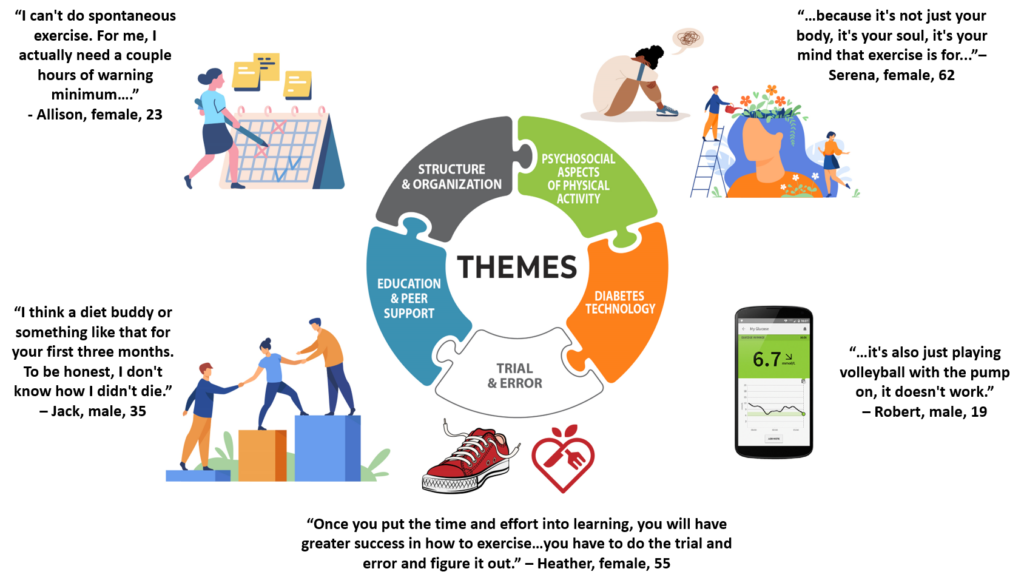
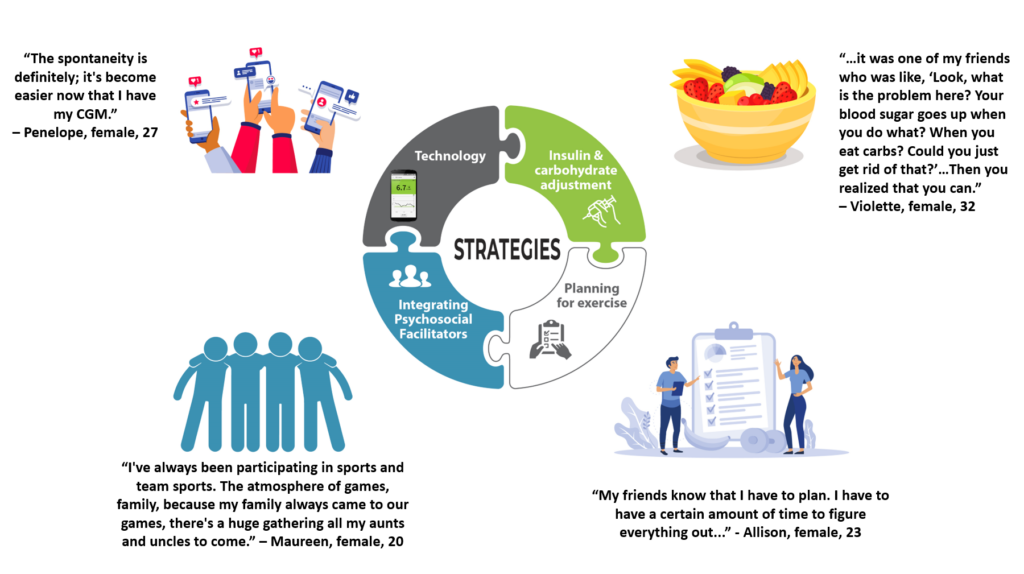
Transcripts from the conversations were analyzed by grouping similar quotes to create 1) themes that came out of the general discussion and 2) specific strategies people said were helpful. General themes with examples of quotes are presented in Figure 1, and specific strategies are in Figure 2.
WHAT DID THE STUDY FIND?
The lived experience of regular exercisers with T1D showed that living an active lifestyle is made easier by:
- Having dedicated structure and organization of routines and planning ahead.
- Accepting the need for trial and error related to both the exercise itself and food to understand how those affect their own blood sugar response. This involves the careful use of food to prevent low blood sugars.
- Technology, which can sometimes present a challenge, but overall is a benefit. This includes using online platforms to connect with others and receive information, and diabetes technology that can help by being able to see blood sugars in real-time.
- Having a support system. This could be a friend or family member, a spouse, or someone else living with T1D.
WHY IS THIS IMPORTANT?
- This information is important because it may help others incorporate physical activity into their lives.
- The information is important to the research team because the themes and strategies could be used as starting points to develop new studies with people living with T1D in mind.
This study has been published. Read the full publication here.
The DISCRETE CHOICE SURVEY Study
THE RESEARCH QUESTION:
What features of a research study that involves an exercise intervention are most preferable to people living with T1D?
WHAT THE RESEARCH TEAM DID TO ANSWER THE QUESTION:
Five different common features of a research study were chosen: exercise type, intensity, program design, time of day, and length of a session. Each feature had different possible options within it. For example, within the “exercise type” feature the options were cardio, strength training, or combined strength and cardio.
A type of survey called a discrete choice experiment was chosen that presents people with different scenarios combining all the different options and asks people to choose their preferred scenario.
Two hundred and forty people completed the anonymous survey. The results were analyzed to show which options people with T1D preferred most. The results are presented in Figure 3.

WHAT DID THE STUDY FIND?
The “Best results” column under the number one represent the options people preferred most in a future study:
Type of exercise: combined cardio and strength
Design: individual no supervision
Intensity: medium intensity
Time: morning and evening were tied
Length: 30-60 minutes
WHY IS THIS IMPORTANT?
It is important for the research team designing new studies to know what options the participants (people with T1D) prefer if the research team is going to design studies that people feel comfortable participating in and want to attend. This gives the study the best chance to collect a lot of information and make new discoveries if people like and attend the study.
Even though it is important to the research team, it may not affect how people living with T1D manage their diabetes.